
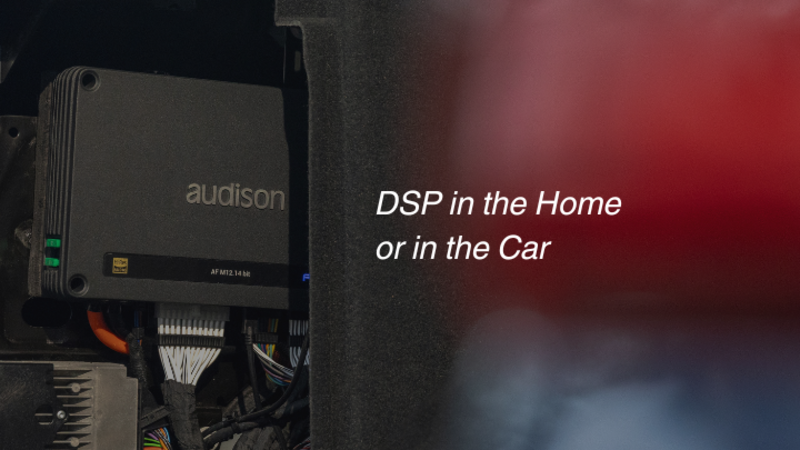
Power is only part of the story when pursuing better sound. Clarity and depth require precision. Whether you’re in a dedicated listening room or behind the wheel of your daily drive, the ability to shape and control the sound can elevate the entire experience.
Digital Signal Processing (DSP) is the intelligence behind many of the great car audio systems we have reviewed in Driving Sounds Magazine. In the home, however, its role is less embraced. A visit to the Bristol HiFi Show in February highlighted how varied opinions on DSP can be in the home audio world.
For some companies, the goal is to achieve clarity through loudspeaker engineering and careful analogue processing rather than digital corrections. Brands such as ATC have long championed this philosophy. They believe that precision in speaker design and system matching, with the use of analogue processing, should remove the need for additional digital intervention.
Others see DSP differently. Even the most thoughtfully arranged listening room is rarely acoustically perfect, and reflections from walls, floors, and windows inevitably affect the sound that reaches the listener. From this perspective, DSP becomes less about altering the characteristics of a system and more about refining how the sound interacts with its surroundings.
Some manufacturers have embraced this approach. At the show, Danish company Lyngdorf Audio was demonstrating the Lyngdorf TDAI-2210 amplifier, which incorporates the company’s
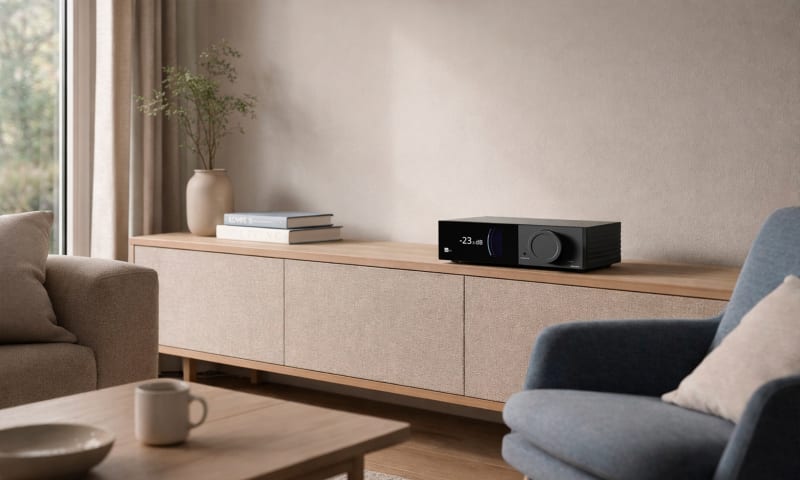
RoomPerfect technology. Rather than replacing your carefully set-up system, solutions such as this are designed to work with the room, adjusting the timing and frequency response subtly to achieve greater cohesion at the listening position.
The Lyngdorf TDAI-2210. Image Credits: The Lyngdorf Audio Website.
The contrast becomes clearer when considering the acoustic environment of a car. Unlike a listening room, where speakers can be positioned with relative freedom, a vehicle places speakers in less-than-ideal locations. They may be low in the doors, close to reflective glass and at varying distances from the listener. When correctly time-aligned, a vocal can be heard directly in front of the listener rather than somewhere down by their shin.
In this environment, DSP becomes more of a practical necessity. Time alignment can transform how a system presents music, allowing sound from each speaker to reach the listener simultaneously and create a coherent soundstage within the cabin.
The conversations at the Bristol HiFi Show served as a reminder that there is rarely a single path to great sound. Some systems achieve it through meticulous analogue design and careful speaker placement. Others use digital tools to refine how sound interacts with its surroundings.
Whether in a listening room or in a car, DSP is simply one more instrument available to those shaping their listening experience. When used, it can reveal small details and immerse you in the music.
Because in the pursuit of better sound, whether at home or on the road, power is rarely the defining factor. Precision is.
Lauren Baillie