Mobile Man Cave
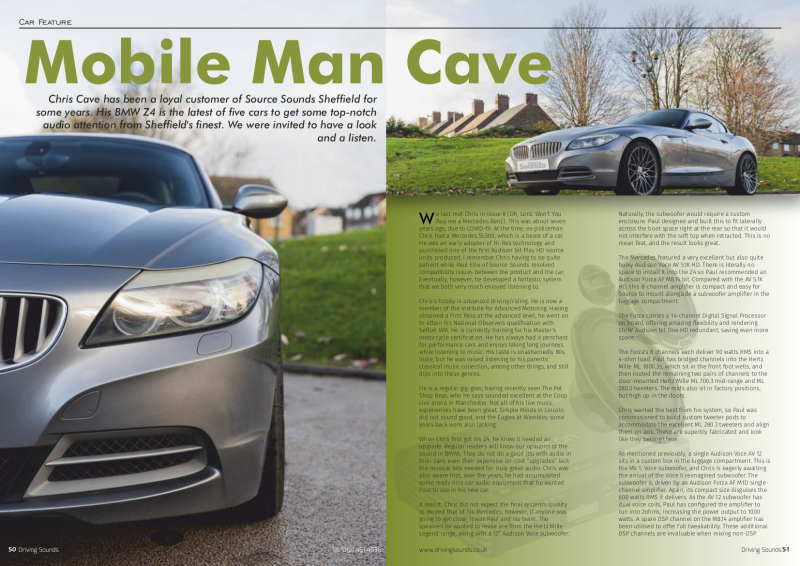
Chris Cave has been a loyal customer of Source Sounds Sheffield for some years. His BMW Z4 is the latest of five cars to get some top-notch audio attention from Sheffield’s finest. We were invited to have a look and a listen.
We last met Chris in issue 8 (Oh, Lord, Won’t You Buy me a Mercedes Benz). This was about seven years ago, due to COVID-19. At the time, ex-policeman Chris had a Mercedes SL500, which is a beast of a car. He was an early adopter of Hi-Res technology and purchased one of the first Audison bit Play HD source units produced. I remember Chris having to be quite patient while Paul Ellis of Source Sounds resolved compatibility issues between the product and the car. Eventually, however, he developed a fantastic system that we both very much enjoyed listening to.
Chris’s hobby is advanced driving/riding. He is now a member of the Institute for Advanced Motoring. Having obtained a First Pass at the advanced level, he went on to attain his National Observers qualification with Sefton IAM. He is currently training for his Master’s motorcycle certification. He has always had a penchant for performance cars and enjoys taking long journeys while listening to music. His taste is unashamedly 80s Indie, but he was raised listening to his parents’ classical music collection, among other things, and still dips into these genres.
He is a regular gig-goer, having recently seen The Pet Shop Boys, who he says sounded excellent at the Coop Live arena in Manchester. Not all of his live music experiences have been great. Simple Minds in Lincoln did not sound good, and the Eagles at Wembley some years back were also lacking.
When Chris first got his Z4, he knew it needed an upgrade. Regular readers will know our opinions of the sound in BMWs. They do not do a good job with audio in their cars; even their expensive on-cost “upgrades” lack the musical bits needed for truly great audio. Chris was also aware that, over the years, he had accumulated some really nice car audio equipment that he wanted Paul to use in his new car.
A realist, Chris did not expect the final system's quality to exceed that of his Mercedes; however, if anyone was going to get close, it was Paul and his team. The speakers he wanted to reuse are from the Hertz Mille Legend range, along with a 12” Audison Voce subwoofer.
Naturally, the subwoofer would require a custom enclosure. Paul designed and built this to fit laterally across the boot space right at the rear so that it would not interfere with the soft top when retracted. This is no mean feat, and the result looks great.
The Mercedes featured a very excellent but also quite bulky Audison Voce AV 5.1K HD. There is literally no space to install it into the Z4 so Paul recommended an Audison Forza AF M8.14 bit. Compared with the AV 5.1K HD, this 8-channel amplifier is compact and easy for Source to mount alongside a subwoofer amplifier in the luggage compartment.
The Forza carries a 14-channel Digital Signal Processor on board, offering amazing flexibility and rendering Chris’ Audison bit One HD redundant, saving even more space.
The Forza’s 8 channels each deliver 90 watts RMS into a 4-ohm load. Paul has bridged channels into the Hertz Mille ML 1800.3s, which sit in the front foot wells, and then routed the remaining two pairs of channels to the door-mounted Hertz Mille ML 700.3 mid-range and ML 280.3 tweeters. The mids also sit in factory positions, but high up in the doors.
Chris wanted the best from his system, so Paul was commissioned to build custom tweeter pods to accommodate the excellent ML 280.3 tweeters and align them on axis. These are superbly fabricated and look like they belong there.
As mentioned previously, a single Audison Voce AV 12 sits in a custom box in the luggage compartment. This is the Mk 1. Voce subwoofer, and Chris is eagerly awaiting the arrival of the Voce II reimagined subwoofer. The subwoofer is driven by an Audison Forza AF M1D single-channel amplifier. Again, its compact size disguises the 600 watts RMS it delivers. As the AV 12 subwoofer has dual voice coils, Paul has configured the amplifier to run into 2ohms, increasing the power output to 1000 watts. A spare DSP channel on the M8.14 amplifier has been utilised to offer full tweakability. These additional DSP channels are invaluable when mixing non-DSP amplifiers with a system that has DSP amplifiers. The .14 designation at the end of the amplifier product code indicates the number of DSP channels on board; hence, 8.14-bit.
An Audison DRC MP CAN remote control provides control of sub level, volume, and balance, and access to multiple setup presets. It is sensibly installed with the screen in full view and controls within easy reach.
The entire installation has been carried out to Source Sounds' typical quality standards. Everything looks classy and right!
Chris told me that he has been learning the bit software. This entails connecting a P.C. (not a police constable), the DSP amplifier, and opening up the software. Once familiar, this is fairly intuitive to use. The biggest problem for me is the sheer amount of adjustments the software allows you to make. A ten-band parametric equaliser on each channel can lead you to days of work, but end up sounding different, not necessarily better. It is not something I would want to tackle, despite my training as a sound engineer.
My approach would be to set crossover points and levels and leave the equalisation well alone. There is a suite of software onboard called Accordo. This, in conjunction with a calibrated, high-quality microphone mounted on the listener’s headrest, enables the software to “listen” to the car’s interior and make adjustments to overcome inherent acoustic challenges. I was sceptical, having heard many similar home hi-fi systems; however, the few Accordo cars I have listened to sound mighty fine to me!
As we cued up our first track for listening, Chris mentioned that although Paul set the car up, Chris had been tweaking it, especially in the bass, as he has specific needs for his low-end.
Chris streams his music from a Fiio streaming device directly into an Audison B-Con receiver. We had a little chat about connectivity. He told me he prefers to connect via SPDIF because he feels the quality is better than Bluetooth, even with LDAC Bluetooth on board. I did not have the chance to A/B test this, but I always use a hardwired connection wherever possible. Personally, my Android Phone streams to the B-Con in my car, delivering good quality. That said, my system is somewhat more modest than Chris’s.
Chris was keen to play me a track by Chris Jones, “Long After You Are Gone”. This track is from his 2000 album, Moonstruck. Unfortunately, Chris is no longer with us, but his music lives on.
This track is superbly recorded, and its minimal arrangement lends itself to critical listening. The track begins with two acoustic guitars, one using a drop bass string tuning, playing a riff that recurs throughout the song. A higher guitar picks out the same riff. At 15 seconds low bass joins the fray. It is hard to tell at first whether this is another discrete instrument or an automatic octave generator, as the playing is so in sync. It soon becomes clear that it is a bass guitar. The bass is rich and comforting, like a huge hug, and in fact, this was my lasting impression of my experience in Chris’s car. The vocal enters at 34 seconds and is saccharine-sweet and deep, working perfectly with the track’s low-end feel. Higher-frequency content gives the guitar strings a crisp, crystal-clear tone with a distinct attack. At 1m15s, a keyboard reveals itself from the mix. It is hard to tell whether this was present earlier, but at a much lower level, even in the quiet sanctity of my home studio. The track continues with warm bass, crystal guitars, and a rich, syrupy vocal. At 3m6s, we hear pinched harmonics on the guitar that pop out and seem to sustain forever! These herald the start of a guitar solo which carried me away. Lasting until 4m21s and climaxing with more pinched harmonics. Absolutely beautiful.
Following this, I threw some more upbeat tracks at the system. All played beautifully. Rhythmically accurate and dynamic. All-in-all, this system takes some beating.
Thank you to Chris and Source Sounds for creating yet another masterpiece!
Chris’s Top Five Tunes
She Sells Sanctuary (Long version) - The Cult
Infinity 2008 (Klaas Vocal Edit) – Guru Josh Project
Lost Without You - Freya Ridings
Teddy Swims – The Door
Anthropocene - OMD
Find out what our partner, The FOUR MASTER Network, can do to bring Hi-Fi quality to your car. Simply put some brief details into the form below.
Not ready for that yet? You can use the same form to book a demonstration at your home, place of work or with your local FOUR MASTER