Audison Forza DSP-Free Amplifiers
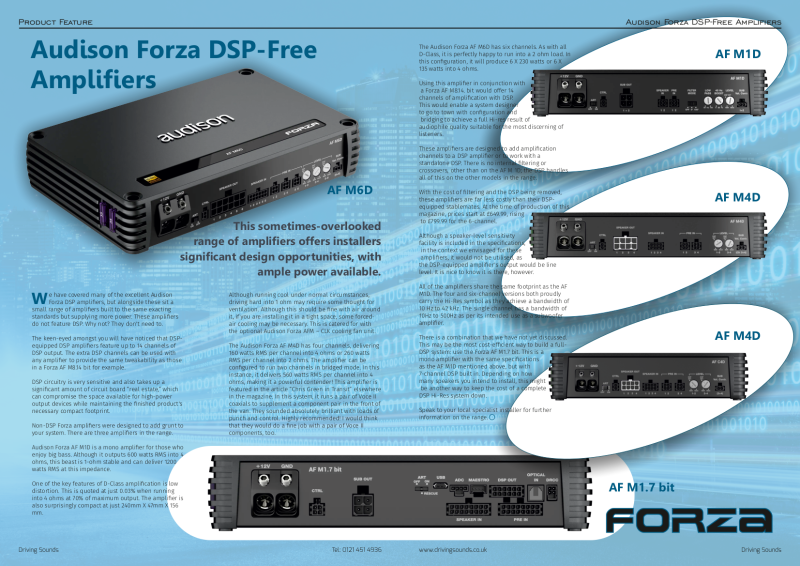
This sometimes-overlooked range of amplifiers offers installers significant design opportunities, with ample power available.
We have covered many of the excellent Audison Forza DSP amplifiers, but alongside these sit a small range of amplifiers built to the same exacting standards but supplying more power. These amplifiers do not feature DSP. Why not? They don’t need to.
The keen-eyed amongst you will have noticed that DSP-equipped DSP amplifiers feature up to 14 channels of DSP output. The extra DSP channels can be used with any amplifier to provide the same tweakability as those in a Forza AF M8.14 bit for example.
DSP circuitry is very sensitive and also takes up a significant amount of circuit board “real estate,” which can compromise the space available for high-power output devices while maintaining the finished product's necessary compact footprint.
Non-DSP Forza amplifiers were designed to add grunt to your system. There are four amplifiers in the range.
Audison Forza AF M1D is a mono amplifier for those who enjoy big bass. Although it outputs 600 watts RMS into 4 ohms, this beast is 1-ohm stable and can deliver 1200 watts RMS at this impedance.
One of the key features of D-Class amplification is low distortion. This is quoted at just 0.03% when running into 4 ohms at 70% of maximum output. The amplifier is also surprisingly compact at just 240mm X 47mm X 156 mm.
Although running cool under normal circumstances, driving hard into 1 ohm may require some thought for ventilation. Although this should be fine with air around it, if you are installing it in a tight space, some forced-air cooling may be necessary. This is catered for with the optional Audison Forza AFM – CLK cooling fan unit.
The Audison Forza AF M4D has four channels, delivering 160 watts RMS per channel into 4 ohms or 260 watts RMS per channel into 2 ohms. The amplifier can be configured to run two channels in bridged mode. In this instance, it delivers 560 watts RMS per channel into 4 ohms, making it a powerful contender! This amplifier is featured in the article “Chris Green in Transit” elsewhere in the magazine. In this system, it runs a pair of Voce II coaxials to supplement a component pair in the front of the van. They sounded absolutely brilliant with loads of punch and control. Highly recommended! I would think that they would do a fine job with a pair of Voce II components, too.
The Audison Forza AF M6D has six channels. As with all D-Class, it is perfectly happy to run into a 2 ohm load. In this configuration, it will produce 6 X 230 watts or 6 X 135 watts into 4 ohms.
Using this amplifier in conjunction with a Forza AF M8.14. bit would offer 14 channels of amplification with DSP. This would enable a system designer to go to town with configuration and bridging to achieve a full Hi-res result of audiophile quality suitable for the most discerning of listeners.
These amplifiers are designed to add amplification channels to a DSP amplifier or to work with a standalone DSP. There is no internal filtering or crossovers, other than on the AF M 1D; the DSP handles all of this on the other models in the range.
The fourth product sits alongside the models already mentioned; however, it is less powerful than the “M” versions listed above. Named Audison Forza AF C4D, it still delivers 90 watts RMS from each of its four channels but has a smaller footprint than the “M” range. It also retails for a lot less than the “M” and, of course, the DSP-equipped versions it accompanies.
With the cost of filtering and the DSP being removed, these amplifiers are far less costly than their DSP-equipped stablemates. At the time of production of this magazine, prices start at £649.99, rising to £799.99 for the 6-channel.
Although a speaker-level sensitivity facility is included in the specifications, in the context we envisaged for these amplifiers, it would not be utilised, as the DSP-equipped amplifier's output would be line level. It is nice to know it is there, however.
All of the amplifiers share the same footprint as the AF M1D. The four and six-channel versions both proudly carry the Hi-Res symbol as they achieve a bandwidth of 10 Hz to 42 kHz. The single channel has a bandwidth of 10Hz to 500Hz as per its intended use as a subwoofer amplifier.
There is a combination that we have not yet discussed. This may be the most cost-efficient way to build a full-DSP system: use the Forza AF M1.7 bit. This is a mono amplifier with the same specifications as the AF M1D mentioned above, but with 7-channel DSP built in. Depending on how many speakers you intend to install, this might be another way to keep the cost of a complete DSP Hi-Res system down.
Speak to your local specialist installer for further information on the range.
Find out what our partner, The FOUR MASTER Network, can do to bring Hi-Fi quality to your car. Simply put some brief details into the form below.
Not ready for that yet? You can use the same form to book a demonstration at your home, place of work or with your local FOUR MASTER