
Fundamentally Harmonious – Hi-Res music from a digital source.
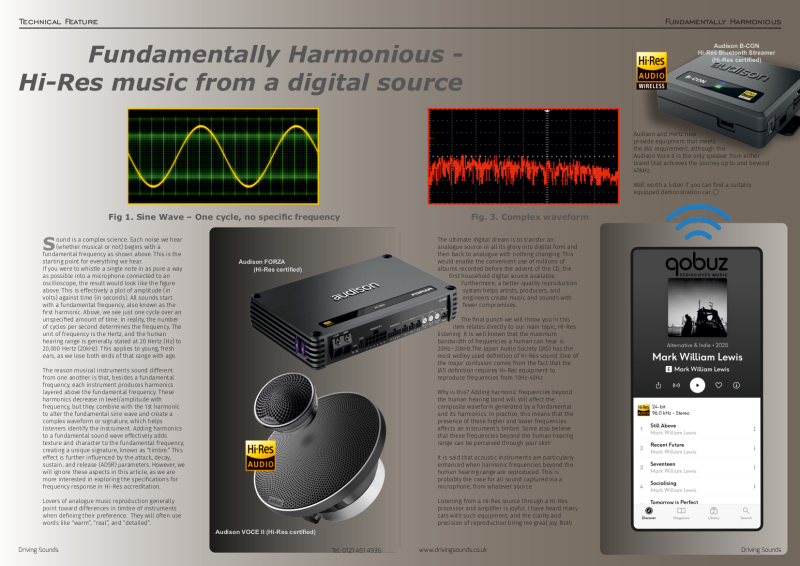
Sound is a complex science. Each noise we hear (whether musical or not) begins with a fundamental frequency as shown above. This is the starting point for everything we hear.
If you were to whistle a single note in as pure a way as possible into a microphone connected to an oscilloscope, the result would look like the figure above. This is effectively a plot of amplitude (in volts) against time (in seconds). All sounds start with a fundamental frequency, also known as the first harmonic. Above, we see just one cycle over an unspecified amount of time. In reality, the number of cycles per second determines the frequency. The unit of frequency is the Hertz, and the human hearing range is generally stated at 20 Hertz (Hz) to 20,000 Hertz (20kHz). This applies to young, fresh ears, as we lose both ends of that range with age.
The reason musical instruments sound different from one another is that, besides a fundamental frequency, each instrument produces harmonics layered above the fundamental frequency. These harmonics decrease in level/amplitude with frequency, but they combine with the 1st harmonic to alter the fundamental sine wave and create a complex waveform or signature, which helps listeners identify the instrument. Adding harmonics to a fundamental sound wave effectively adds texture and character to the fundamental frequency, creating a unique signature, known as “timbre.” This effect is further influenced by the attack, decay, sustain, and release (ADSR) parameters. However, we will ignore these aspects in this article, as we are more interested in exploring the specifications for frequency response in Hi-Res accreditation.
Lovers of analogue music reproduction generally point toward differences in timbre of instruments when defining their preference. They will often use words like “warm”, “real”, and “detailed”.
The ultimate digital dream is to transfer an analogue source in all its glory into digital form and then back to analogue with nothing changing. This would enable the convenient use of millions of albums recorded before the advent of the CD, the first household digital source available. Furthermore, a better-quality reproduction system helps artists, producers, and engineers create music and sounds with fewer compromises.
The final punch we will throw you in this item relates directly to our main topic, Hi-Res listening. It is well known that the maximum bandwidth of frequencies a human can hear is 20Hz—20kHz. The Japan Audio Society (JAS) has the most widely used definition of Hi-Res sound. One of the major confusions comes from the fact that the JAS definition requires Hi-Res equipment to reproduce frequencies from 10Hz—40kHz.
Why is this? Adding harmonic frequencies beyond the human hearing band will still affect the composite waveform generated by a fundamental and its harmonics. In practice, this means that the presence of these higher and lower frequencies affects an instrument's timbre. Some also believe that these frequencies beyond the human hearing range can be perceived through your skin!
It is said that acoustic instruments are particularly enhanced when harmonic frequencies beyond the human hearing range are reproduced. This is probably the case for all sound captured via a microphone, from whatever source.
Listening from a Hi-Res source through a Hi-Res processor and amplifier is joyful. I have heard many cars with such equipment, and the clarity and precision of reproduction bring me great joy. Both Audison and Hertz now provide equipment that meets the JAS requirement, although the Audison Voce II is the only speaker from either brand that achieves the journey up to and beyond 40kHz.
Well worth a listen if you can find a suitably equipped demonstration car.
Find out what our partner, The FOUR MASTER Network, can do to bring Hi-Fi quality to your car. Simply put some brief details into the form below.
Not ready for that yet? You can use the same form to book a demonstration at your home, place of work or with your local FOUR MASTER